
Choosing an Ultrasonic Welding Machine: Specs That Matter
20 July 2026 · 8 min read · Techspan engineering
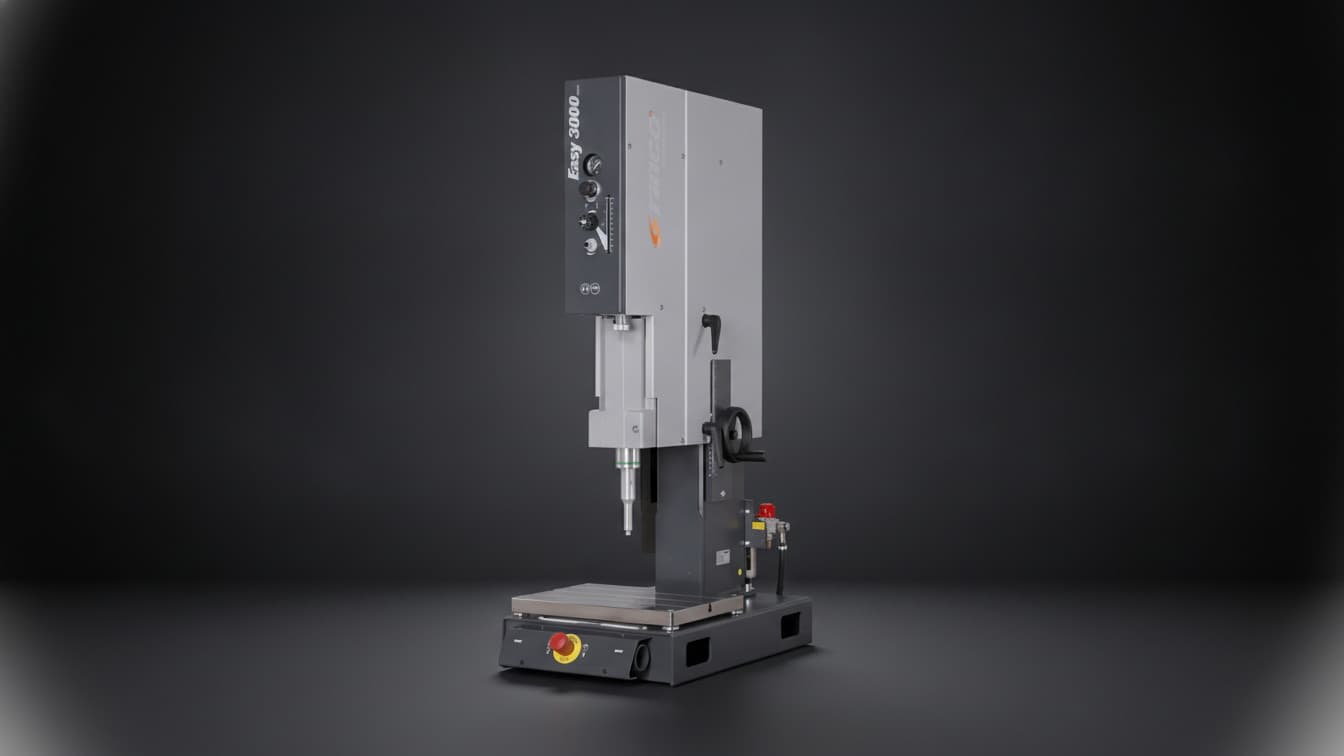
Ultrasonic welders all look broadly similar — a press, a stack, a generator, a control panel. The differences that matter are in the specification: frequency, force, stroke, actuation and power. Choose those correctly and the machine disappears into the background of a reliable process. Choose them by guesswork and you fight the equipment for years. This guide walks through each decision in the order we work through them with customers.
Start with the part, not the machine
Every specification decision flows from four things about your application:
- Part size and weld area — how large is the joint, and how far is it from where the horn can contact the part?
- Material — amorphous (ABS, PC, PMMA, PS) or semi-crystalline (PP, PE, PA, POM)? Filled or unfilled?
- Cosmetic requirements — is horn marking on a visible surface acceptable?
- Volume and takt time — dozens a day on a bench, or thousands a shift in a cell?
20 kHz or 35 kHz?
Frequency is the first fork in the road, because it sets the physics of everything downstream. Lower frequency means longer acoustic wavelength, which means larger tuned components, larger horns and higher amplitude capability. Higher frequency means smaller tooling, lower amplitude and gentler treatment of the part.
| Factor | 20 kHz | 35 kHz |
|---|---|---|
| Typical part size | Medium to large parts, bigger weld areas | Small to medium parts, fine detail |
| Amplitude capability | Higher — suits semi-crystalline materials (PP, PE, PA) | Lower — suits amorphous materials and delicate joints |
| Part marking | More risk on cosmetic surfaces | Less marking, gentler contact |
| Audible noise | Louder (strong 10 kHz subharmonic) | Noticeably quieter |
| Tooling size | Larger horns available | Compact horns, limited maximum size |
| Damage risk to sensitive internals | Higher vibration loads | Lower — preferred for parts with electronics |
Rules of thumb: large polypropylene housings, filters and tough structural welds want 20 kHz. Small connectors, medical components, cosmetic housings and anything with delicate internals want 35 kHz. Plenty of parts could go either way — which is when sample welding settles it.
Force and stroke
The press must apply the right force range for your joint, with resolution at the bottom end. A machine with a huge maximum force but coarse control at low forces is the wrong machine for small parts — trigger force and weld force for delicate components can be a few tens of newtons. Conversely, large parts with long joint lines need sustained higher forces that a light-duty press cannot deliver consistently.
Check stroke and daylight too: the working stroke must cover part loading and any fixture height, and throat depth must reach the joint on your largest part. If you expect the product range to grow, buy working envelope now — it is the one thing you cannot add later.
Pneumatic or electric actuation?
Most ultrasonic welders use a pneumatic cylinder to drive the horn — simple, robust and well proven. Rinco's Electrical Motion series replaces the cylinder with a servo-electric drive, and the difference is control:
- Pneumatic — force is set by pressure regulation; speed by flow restrictors. Repeatable and economical, and entirely adequate for the majority of applications.
- Servo-electric — position, velocity and force are all programmable through the weld. The machine can approach fast, touch gently, profile the force during melting, and hold a precise collapse depth. That level of control shows up as tighter weld consistency, better handling of fragile parts, and richer process data for validation-heavy industries such as medical devices. It also removes compressed air from the equation entirely.
If your parts are forgiving and your quality system is happy with time or energy mode welding, pneumatic machines are the economical choice. If you need distance-mode precision, force profiling or full traceability, the servo route earns its price quickly.
Generator power
Generator power ratings indicate how much energy the machine can deliver into the weld, and the requirement scales with weld area, material and joint design. Small parts at 35 kHz may need only a few hundred watts; large 20 kHz welds in semi-crystalline materials can demand several kilowatts. Two practical points:
- Power is capability, not consumption. A 3000 W machine welding a small part draws only what the weld needs. Buying headroom does not waste energy — it buys flexibility for future parts.
- Undersized power shows up as long welds and overloads. If the generator cannot deliver energy fast enough, weld times stretch, heat spreads beyond the joint, and quality suffers. When in doubt, size up.
Modern digital ultrasonic generators also handle frequency tracking and amplitude regulation automatically, keeping output stable as the stack warms through a shift.
Benchtop or automation?
The same Rinco ultrasonic technology comes in several formats:
- Benchtop press systems — the workhorse format for manual and semi-automatic assembly. The Standard 3000 (20 kHz) covers larger and tougher welds; the Easy 745 and Easy 3000 offer a streamlined control set at 35 kHz and 20 kHz respectively — well suited to straightforward applications where a full process-control suite is not required. The Dynamic series adds Rinco's most advanced process control on the same footprint, and the Electrical Motion machines bring servo actuation.
- Actuators and OEM components — for special-purpose machines and automation cells, the same stacks and generators are available as build-in actuators and modules, so an integrator can put Rinco welding inside a custom line.
- Workstations with enclosures — rotary-table and automatic-draw sound enclosure workstations combine acoustics, guarding and part handling for production cells.
Do not skip the sample weld
Whatever the data sheets say, the only proof that a machine suits your part is a weld on your actual part. A proper trial answers the questions no specification table can: whether the joint design works as moulded, what amplitude and force the material really wants, how the part marks, and what the realistic cycle time is. It also surfaces problems while they are still cheap — a joint that needs a moulding tweak, a fixture that needs better support, a cosmetic surface that wants 35 kHz instead of 20 kHz. Techspan runs sample welds for customers as a normal part of specifying a machine, and the results become the baseline settings when your equipment arrives.
A specification checklist
- Confirm material weldability and joint design first — no machine fixes a bad joint.
- Choose frequency: 20 kHz for size and tough materials, 35 kHz for small, delicate or cosmetic parts.
- Check force range (including low-end resolution), stroke and throat against your largest and smallest parts.
- Decide pneumatic vs servo-electric based on precision and traceability needs.
- Size generator power with headroom for the biggest weld you can foresee.
- Plan the format — benchtop, enclosure workstation or automation module — around real volumes.
- Insist on sample welds on your actual parts before ordering.
Talk to Techspan
Techspan is the authorised distributor for Rinco Ultrasonics in Australia, supplying the full range from benchtop welders to automation components — with local applications advice, sample welding and after-sales service. Tell us about your part and we will recommend a machine specification you can hold us to. Get in touch.